
We sometimes forget in the modern world the many advantages digital technology offers for everyday life. Digital technology has made everything quicker, more available, and more dependable from the way we interact with loved ones to how companies run or how students access learning materials. But why is digital technology so much more useful than analog technology, which formerly predominated these domains? The solution is in the character of digital signals and their resistance against corruption and noise. Digital signals run in binary form, employing only two values—0s and 1s, unlike continuous, sometimes variable analog signals. One of the main reasons digital technology has essentially supplanted analog technology is simplicity.
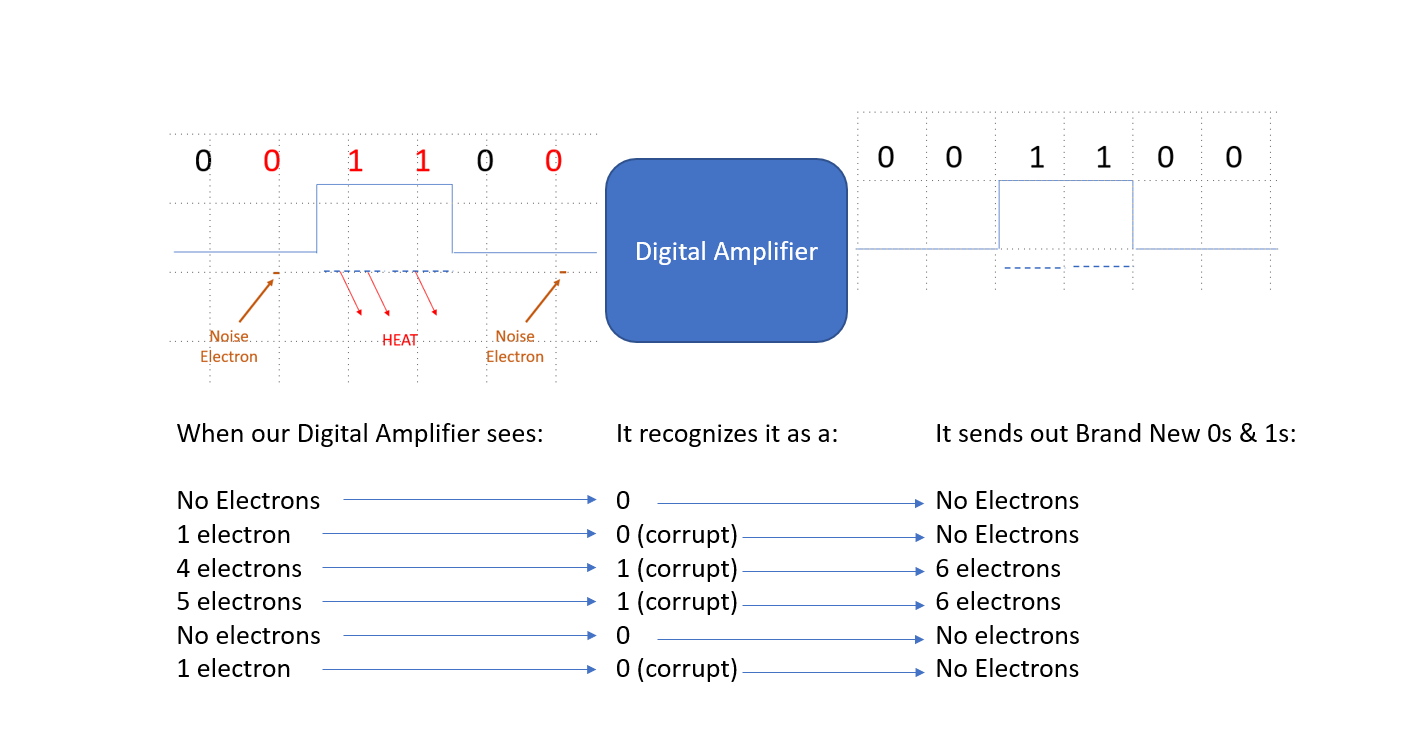
This diagram offers an excellent visualization of this concept through the example of a digital amplifier. In analog systems, any tiny interference—such as a stray electron—can alter the quality of the signal. This “noise” distorts the data, making analog systems more prone to error. Heat, electrical noise, or even tiny imperfections can cause unwanted variations in the signal, and once the signal is corrupted, it’s difficult to recover the original message. In contrast, digital systems are designed to be far more resilient. A digital amplifier doesn’t care about small variations or minor noise. As long as the signal is strong enough to be interpreted as either a ‘0’ or a ‘1’, the amplifier can correct and clean the signal, ensuring accurate information is sent to the next stage. Even if there’s a little extra noise or distortion, the digital amplifier processes and restores the data to its correct state.
This ability to correct errors and maintain consistency is a primary reason why digital technology has overtaken analog. Digital systems offer many benefits, starting with consistency. Digital signals can be perfectly replicated, and once data is encoded into 0s and 1s, it can be copied and transmitted without any degradation over time. Analog signals, on the other hand, degrade with every copy. Error correction is another powerful feature. As shown in the diagram, even when a digital signal becomes corrupted by noise or interference, digital systems can detect and restore the signal. This reliability ensures that the information received is the same as the information sent, even after multiple transmissions.
Prompt: Explain why digital technology has largely replaced analog technology.
Response: From the way we communicate with loved ones to the way businesses operate or how students access educational resources, digital technology has made everything faster, more accessible, and more reliable. But why is digital technology so much more advantageous than analog technology, which once dominated these fields?
The answer lies in the nature of digital signals and their robustness against noise and corruption. Unlike analog signals, which are continuous and can vary in subtle ways, digital signals operate in a binary fashion, using only two values—0s and 1s. This simplicity is one of the key reasons why digital technology has largely replaced analog technology.
Let’s explore what makes digital so powerful by breaking it down through an example:
Let’s consider how a digital amplifier processes a signal. In analog systems, any tiny interference—like a stray electron—can alter the quality of the signal. This “noise” distorts the data, making analog systems more prone to error. Heat, electrical noise, or even tiny imperfections can cause unwanted variations in the signal, and once the signal is corrupted, it’s difficult to recover the original message.
In contrast, digital systems are designed to be far more resilient. A digital amplifier doesn’t care about small variations or minor noise. As long as the signal is strong enough to be interpreted as either a ‘0’ or a ‘1’, the amplifier can correct and clean the signal, ensuring accurate information is sent to the next stage.
Take the scenario shown in the diagram:
The original digital signal might experience some corruption (like extra electrons, noise, or heat) as it travels.
In the analog world, this noise would cause distortion, which could lead to degraded audio quality or unclear video.
However, in a digital system, the amplifier ignores minor noise, recognizing the signal based on its thresholds. Even if there’s a little extra “noise electron” or heat, the digital amplifier knows that the corrupted signal should be a ‘0’ or a ‘1’ and cleans it up. The result is a brand new, clean signal, free of errors.
Why Digital Dominates
This capacity for error correction and resilience to noise is one of the primary reasons digital technology has dominated analog. It provides:
Consistency: Digital signals can be perfectly replicated. Once data is encoded into 0s and 1s, it can be copied and transmitted without degradation over time, unlike analog signals that degrade with each copy.
Error Correction: As illustrated by the digital amplifier in the diagram, digital systems can identify and correct corrupted signals. Even if the initial data is slightly distorted by noise, the system can restore it to its original form.
Scalability: Digital technology allows data to be stored, compressed, and transmitted efficiently. Whether it’s streaming a high-definition movie or making a long-distance video call, digital technology scales with the demand.
Precision: In the analog world, capturing or reproducing continuous values (like sound waves or images) is imperfect. However, by converting information into a series of 0s and 1s, digital systems can store and manipulate data with perfect accuracy.
Applications of Digital Technology
Today, digital technology plays a role in nearly every aspect of our lives. In communication, digital signals power everything from mobile phones to the internet, providing instant, high-quality transmission of voice, video, and text. In entertainment, digital formats like streaming platforms offer endless content without the signal degradation that analog systems suffer from. In education, digital tools provide immediate access to vast libraries of information, enabling a more interactive and personalized learning experience.
Even industries like healthcare benefit from digital technology. For instance, medical imaging techniques, such as MRI scans, rely on digital systems to create clear, accurate images that can be easily stored and analyzed. The same technology is used in digital sensors, robotics, and countless other areas to improve efficiency and accuracy.
Conclusion: The Digital Future
Digital technology has revolutionized the world by offering an efficient, error-resistant alternative to analog systems. The resilience of digital signals to noise and corruption ensures that data remains consistent, precise, and easily reproducible, allowing for a vast range of applications that continue to expand.
As we continue to move further into the digital age, this powerful technology will only become more integral to our lives, empowering new innovations and reshaping industries. The magic of digital lies not just in its binary simplicity but in its ability to solve real-world challenges in ways that analog systems never could.