
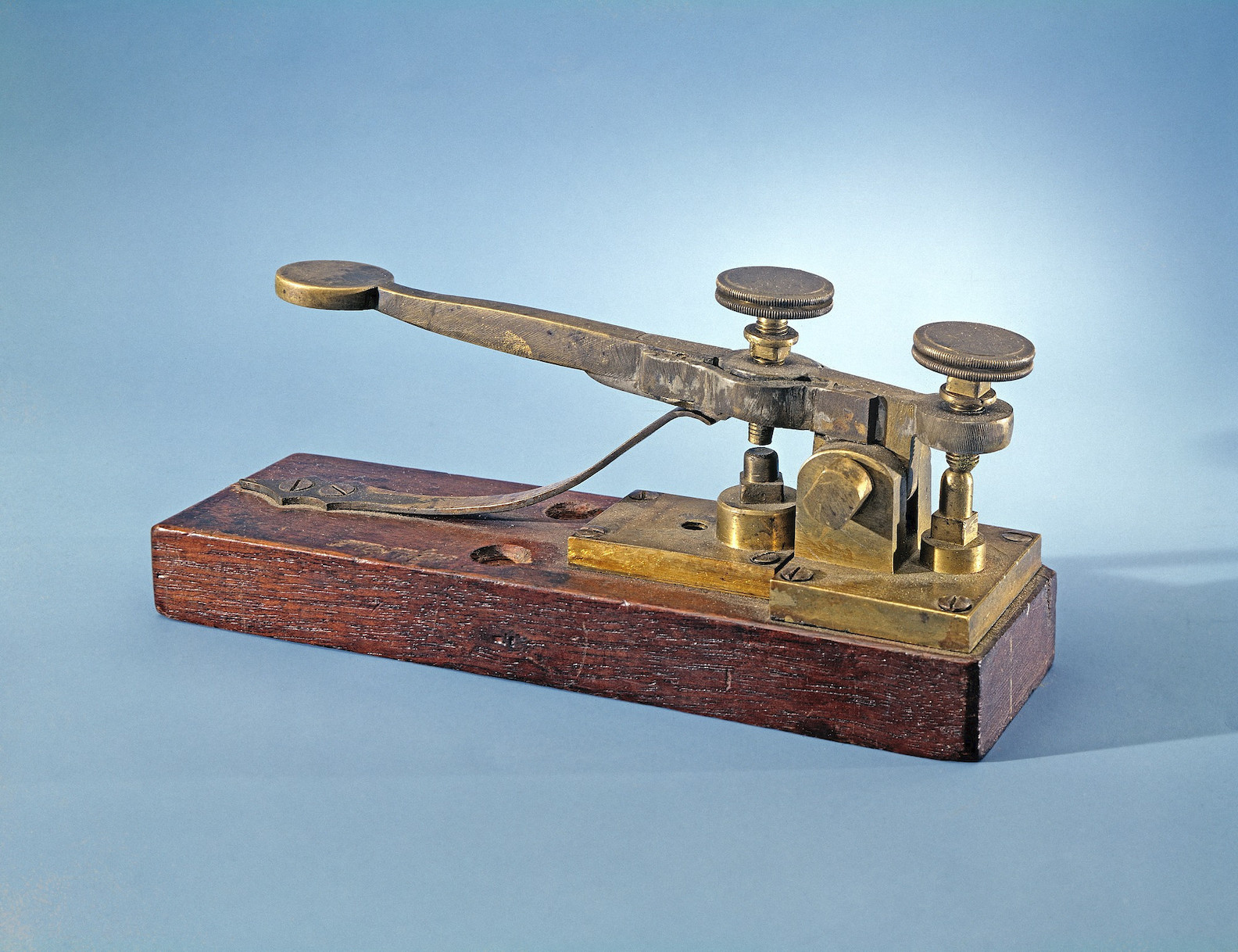
Did you know that the key to the digital world we live in today was the relatively simple development of the telegraph? Samuel Morse’s invention, the telegraph, allowed people to communicate instantly across great distances in an era before cellphones and the internet, but it all began with a very personal tragedy.
The Creative Spark: Born from Loss
When Samuel Morse’s wife died, the telegraph’s inspiration originated from the message he received too late via conventional snail mail. Driven by loss and frustration, Morse developed the telegraph by imagining a device that could transmit messages very instantly.
Standing on the Shoulders of Giants: The Technological and Economic Foundations
Building on already-existing technology including electromagnets and other trials with signal transmission, Morse’s telegraph Though others had seen complication, Morse recognized the chance for simplicity. He broke out the technology into something everybody could use by streamlining it.
First transatlantic cables, a forerunner of contemporary world communications, were constructed by 1858. And while the initial 300 miles of wire put in the United States appeared like an achievement at the time, by the start of the Civil War the network had expanded to 15,000 miles. Economically, the telegraph transformed sectors by enabling companies to handle transactions remotely, interact faster, and access markets never previously feasible. As the top telegraph firm in the United States, Western Union became somewhat dominant very fast.
Morse’s Vision: Simplicity in the Machine, Complexity in the Code
Samuel Morse selected simplicity for the telegraph itself, leaving the complexity to human brain; his genius lay not in designing a system loaded with sophisticated machinery. Fundamentally, the telegraph was a basic tool used to transmit electrical pulses over wires. But Morse realized that creating a system capable of intricate but effective information encoding was the secret to speedier transmission, not in overcomplicating the mechanism.
This is where Morse Code comes in. Although the telegraph depended on a set of basic signals—dots and dashes—Morse’s method was brilliant in that the code itself was the true intricacy. By allowing operators to condense communications into brief series of electrical pulses, Morse Code greatly shortened the time required to transmit a message across great distances. The computer just sent the signals; human intellect was needed to decipher and analyze them. The result was a faster, more efficient way to transmit complex messages—a fundamental shift that laid the groundwork for future innovations in digital communication.
From ChatGPT 4o mini
Prompt: Explain the invention of the telegraph. Write in the form of a blog, it should read like a magazine article (or a blog post), not an assignment. Make it interesting. You might want to start it with “Did you know …”
Response: The Telegraph: A Spark for the Digital Age
Did you know that the telegraph, a relatively simple invention, was the key that unlocked the door to the digital world we know today? In an era before the internet and smartphones, Samuel Morse’s revolutionary telegraph made it possible to communicate across vast distances in the blink of an eye, and it all started with a very personal tragedy.
The Creative Spark: Born from Loss
The inspiration for the telegraph came when Samuel Morse’s wife passed away, and the message informing him of her death arrived too late via traditional snail mail. Driven by grief and frustration, Morse envisioned a system that could deliver messages nearly instantaneously, sparking the invention of the telegraph.
Standing on the Shoulders of Giants: The Technological and Economic Foundations
Morse’s telegraph built on existing technologies, including electromagnets and earlier experiments with transmitting signals. But where others had seen complexity, Morse saw the opportunity for simplicity. He simplified the technology into something accessible, creating a system that anyone could use.
By 1858, the first transatlantic cable was laid, a precursor to modern global communications. And while the first 300 miles of wire laid in the U.S. seemed like a feat at the time, the network had grown to 15,000 miles by the start of the Civil War. Economically, the telegraph revolutionized industries, allowing businesses to communicate faster, manage transactions remotely, and expand their reach in ways never before possible. Western Union quickly rose to dominance as the leading telegraph company in the U.S.
Navigating Politics and Public Skepticism
The political landscape also presented challenges for Morse. Telegraph wires had to cross multiple state lines and even international borders. Convincing governments to allow the installation of this groundbreaking technology took time. On a societal level, Morse also had to persuade people that this new technology was both practical and reliable, a tough sell in an age of face-to-face interactions.
Despite these hurdles, the social effects were immense. The telegraph connected people across regions in ways that had previously been unimaginable, making it easier to communicate with distant loved ones and creating opportunities for businesses to collaborate more efficiently.
Morse’s Vision: Simplicity for the People
Samuel Morse’s genius lay not just in creating a working telegraph, but in making it easy for others to use. His development of Morse Code—a series of dots and dashes—was designed to be simple and intuitive, allowing even untrained operators to transmit messages. While the technology behind the scenes was complex, the user experience was streamlined, putting the power of communication into the hands of ordinary people.
A Digital Revolution in Disguise
Although the telegraph predated what we now consider the “digital age,” its concepts laid the foundation for the digital revolution. It was the first example of information being transmitted independently of its medium—a core principle in today’s digital communications. The ability to separate the message from the wire or cable carrying it was revolutionary.
The lessons we learned from the telegraph, such as how noise can interfere with a signal and alter its meaning, still resonate today. In a sense, Morse’s work was the first step toward the digital world, where clean, efficient transmission of information reigns supreme.